
Lu‘uLive uses wind, wave, and rain data to score the “diveability” of a given spot. Diveability is a general term for how suitable the ocean conditions are for a diver to explore an area. We describe diveability using three ratings:
- Good: Safe and overall enjoyable.
- Fair: Acceptable but not ideal.
- Poor: Challenging, unsafe.
The general premise is that wind and waves impart energy on the ocean, making conditions undesirable for a diver. Ocean energy wreaks havoc by reducing underwater visibility (see Rule of Thumb below), tearing up the water surface, and thrashing divers around unpredictably. As a result, Lu‘uLive applies “good” ratings in the absence of surf and winds.
Each dive spot receives a diveability score based on a weighted average of wind, waves, and rain. Waves—specifically wave height—have the most significant influence on the score. When wave height is high, it drags the diveability score toward “poor.” Conversely, small waves boost the score toward “good.” Wind is the second most influential component: strong winds mean poor diveability. Rain has a minor impact, but if there is a significant amount of rain (more than 0.5 inches in 24 hours), it acts as a kill switch and automatically rates the spot “poor,” because we assume brown water from land-based runoff.
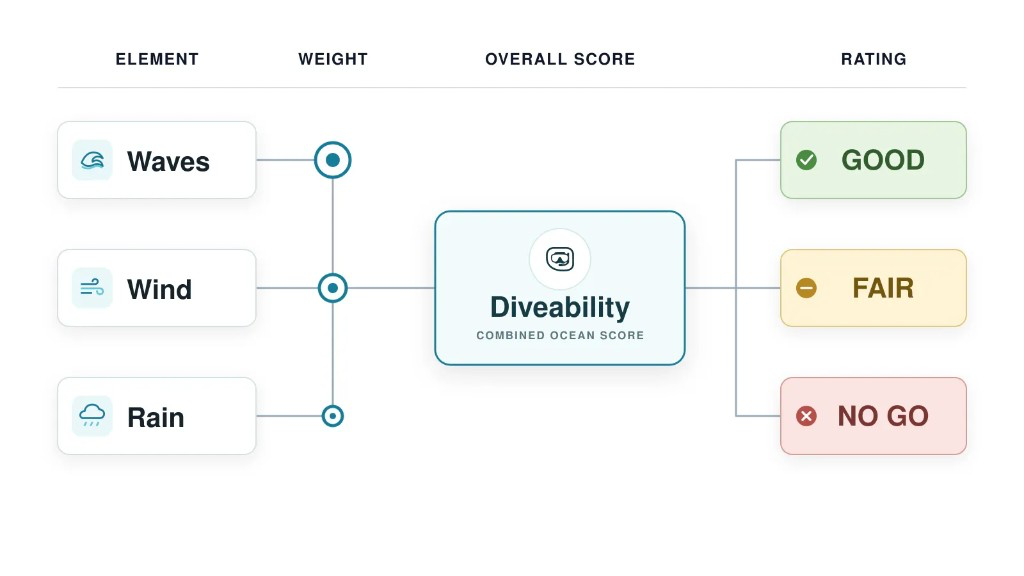 How Lu‘uLive translates wave, wind and rain data into a diveability rating.
What Do “Good” and “Poor” Ratings Mean?
Good conditions generally have a calm, glassy water surface. Entry and exit zones have wave heights less than 2 ft, so the risk of injury or loss of equipment is lower. Underwater visibility is +50 ft. The surge from waves should be minor and the ocean current mild—neither should impede your ability to navigate the water easily.
Poor conditions have choppy water surfaces that make it difficult to catch a breath at the surface without getting slapped in the face by a wave. High surf (+4 ft wave faces) is associated with poor conditions, which can be problematic for many reasons. Entering through large waves can be dangerous because a wave could throw a diver onto a nearby rock or coral head. Even if you make it past the shorebreak, large waves can be disorienting in the open sea. Waves can also generate rip currents that rapidly pull a diver offshore. Typically, we expect water visibility to be murky where there is high surf.
Rule of Thumb: Underwater Viz
Calm surface conditions = clear water, good visibility.
Turbulent surface conditions = murky water, poor visibility.
Ocean energy tends to kick up sediment from the sea bed, creating murkiness from the water–sediment mixture. However, this rule has mysterious exceptions. Some days seem calm on the surface, but once you enter the water, the visibility is unexpectedly poor. The opposite can also be true: some days with big waves and strong winds produce violent surface conditions, but the visibility underneath is surprisingly clear.
Tip: Underwater visibility always improves as you swim offshore. Deeper water is more “pure” and absent of sediment from land.
Data Sources
- Wave and wind forecasts are provided by the Pacific Island Ocean Observing System (PacIOOS), a National Oceanic and Atmospheric Administration (NOAA) program.
- Rainfall forecasts are provided by the National Weather Service (NWS).
Future Feature: Viz Predictor
In the future, Lu‘uLive aims to provide highly accurate underwater visibility reports and forecasts. This is an ongoing research and development effort. The end result will resemble a rain forecast. Because underwater visibility—synonymous with water quality—is a function of so many oceanographic variables, it changes quickly in time and space.
Like rain forecasts, there’s a spectrum of outcomes in underwater visibility. Rain predictions range from clear skies to torrential downpour in a given zip code. With underwater visibility, water can range from incredibly murky to crystal clear at a given site. There’s inherent uncertainty for both.
Despite a high-confidence rain forecast for heavy downpours, one can look across the valley and see another area getting rained on while standing in the sun. Similarly, two divers at the same site—albeit different locations within that site—may observe different levels of clarity in the water.
Due to the mysteriousness of the ocean, we may never be able to say intra-site which areas are more murky than others, or predict momentary sweeps of unusually murky water. Ideally, though, we can identify the extremes. For example, we hope to forecast when we will have incredibly clear or especially murky waters. Once we figure that out, we can work on improving predictions for more moderate levels of clarity. Stay tuned!
Sincerely,
Matthew Feeley
Founder